
Berlin, Germany
HSS Facilitates German-Uzbek Exchange on Digital Governance and Public Sector Innovation
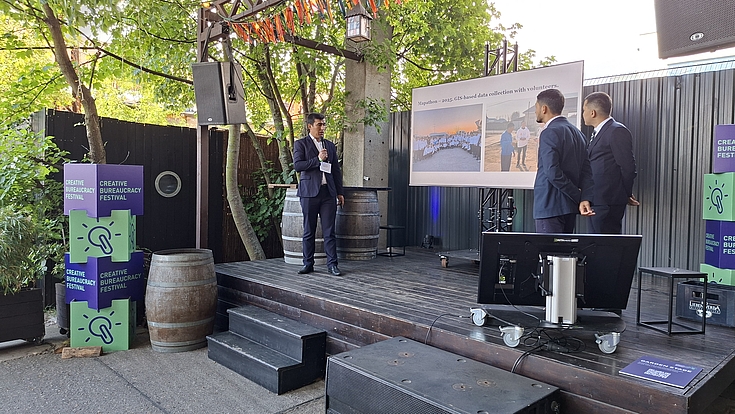
The delegation showcased how GIS-based field surveys and volunteer-driven data collection are used to create reliable datasets for strategic planning, infrastructure prioritisation and public service delivery. The presentation demonstrated how digital tools and citizen participation strengthen transparency and informed decision-making.
The Creative Bureaucracy Festival, one of the world's leading events dedicated to innovation in the public sector brought together public officials, researchers, innovators and practitioners from across the globe and provided an opportunity to exchange experiences and ideas on modern governance, digital transformation, citizen engagement and public sector leadership.
The Uzbekistan's delegation included three experts responsible for infrastructure development, innovation and geospatial analytics within ZBIO. Throughout the programme, discussions explored how digital technologies, evidence-based policymaking and cross-sectoral cooperation can improve public service delivery and enhance the effectiveness of government institutions.
The highlight of the delegation was a presentation on "Curing Institutional Blindness: Data-Driven Strategy Planning in Uzbekistan" at the Creative Bureaucracy Festival 2026 delivered by the Uzbek delegation. The presentation showcased Uzbekistan's experience in applying data-driven governance tools to strategic planning and public investment management.
Participants learned how the country’s Strategy Dashboard and Geoportal support the prioritisation of infrastructure projects through multi-criteria analysis, integrate data from multiple government institutions with citizen-generated information, and strengthen evidence-based decision-making, transparency and accountability. The presentation generated considerable interest among international participants and contributed to discussions on how digital solutions can improve the responsiveness and effectiveness of public administration.
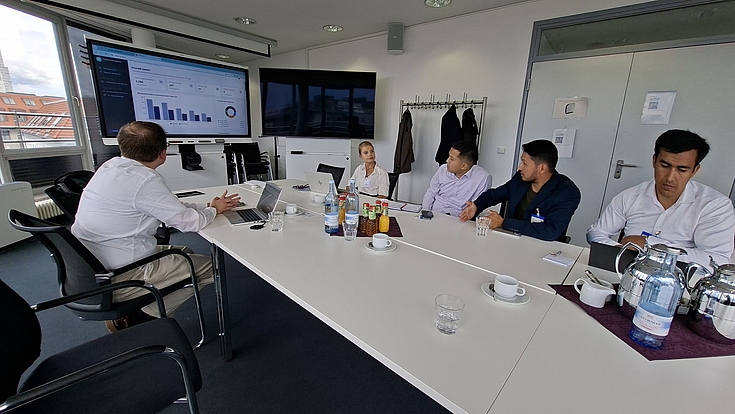
Meeting with experts from the Institute for Innovation and Technology (iit) in Berlin, where the delegation presented Uzbekistan's Strategy Dashboard and Geoportal and exchanged experiences on digital governance, innovation management and evidence-based public administration.
The delegation also met with experts from the Institute for Innovation and Technology (iit) in Berlin to exchange experiences on approaches to digital local government, innovation management and technology-driven public administration. During the discussions, ZBIO representatives presented Uzbekistan's Strategy Dashboard and Geoportal as practical examples of integrating geospatial data and real-time monitoring into strategic planning, public investment decisions and performance management across government institutions. The case of Uzbek innovation in digital public administration highlights the country's efforts to integrate administrative data, operational information and citizen feedback into a unified digital platform for evidence-based decision-making.
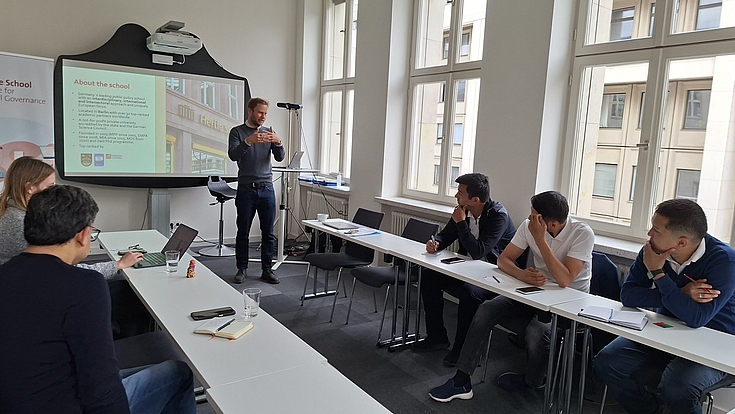
The delegation visited the Hertie School's Centre for Digital Governance to discuss digital transformation, AI in government, open-source digital infrastructure and opportunities for future cooperation in executive education and institutional capacity development.
In addition, the delegation visited the Hertie School's Centre for Digital Governance, where discussions focused on digital transformation, artificial intelligence in government, open-source digital infrastructure and executive education for public officials. Participants also explored opportunities for future cooperation through tailored training programmes, and institutional capacity development between German and Uzbek partner institutions. the delegation participated in a panel discussion on "The Financial Viability of the Welfare State – Safeguarding the Social System of the Federal Republic of Germany," organized by the Hanns Seidel Foundation Berlin Office and the Representation of the Free State of Bavaria in Berlin. The discussed offered further opportunities to exchange perspectives with German policymakers and experts on current governance and public policy challenges.
The study visit demonstrated the value of international knowledge exchange in supporting practical public administration reform. By placing Uzbekistan's own reform experience on an international innovation stage, while facilitating dialogue with leading German institutions, the programme strengthened professional networks, identified concrete opportunities for future cooperation and reaffirmed the Hanns Seidel Foundation's commitment to supporting evidence-based governance reforms, innovation and capacity development in Uzbekistan.
Kontakt

Regionalleiter Zentralasien